ASAL System Stability Index (ASSI)
Overall System Stability Score
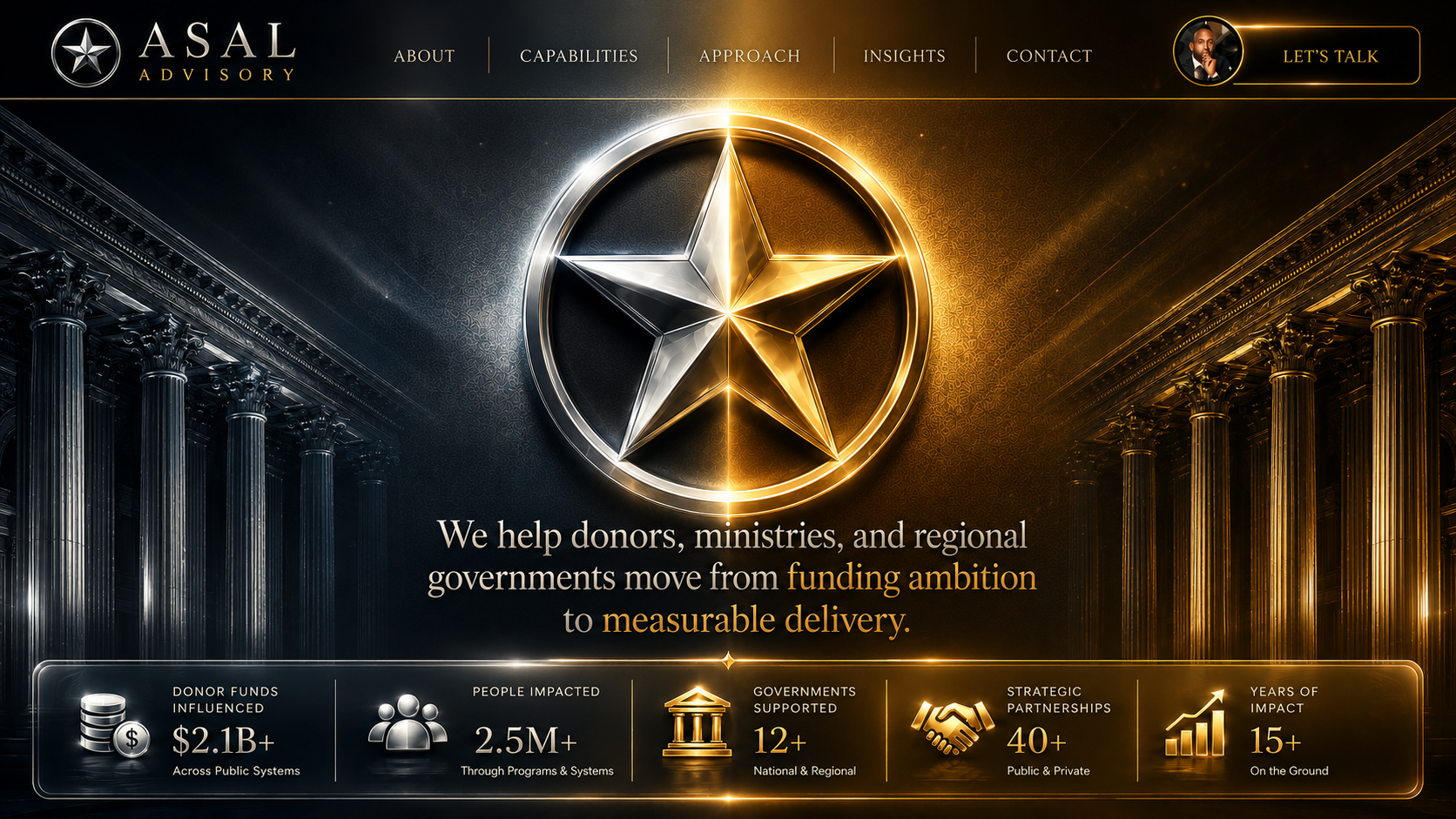
ASAL helps funders, ministries, regional governments, and civic institutions convert ambition into measurable delivery. Led by Mohamed Shidane, ASAL combines institution building, public-sector strategy, funding architecture, and data intelligence into one accountability operating layer.
ASAL sits between public ambition and measurable delivery. The work is not only advisory; it is operating design for moments when institutions, funders, governments, and communities need the same system to hold.
Map donor movement, funding gaps, investment logic, and the real case for public value.
Clarify authority, roles, accountability rhythm, implementation control, and decision rights.
Build stakeholder confidence before delivery pressure exposes weak legitimacy.
Use dashboards, scenario modeling, and risk signals before failure becomes visible.
Funding, governance, trust, data, and delivery are often treated as separate workstreams. ASAL closes that gap by building the operating structure that connects them.
Every image on this site is treated as evidence: access, trust, convening power, capital alignment, and execution.
Funders, stakeholders, constraints, risks, delivery pressure, and the incentives shaping the operating environment.
Governance, roles, reporting cadence, implementation logic, decision rights, and accountability architecture.
Scenarios, funding gaps, delays, confidence risk, continuity pressure, and what-if decision paths.
Impact through dashboards, briefings, audits, public-trust proof, and evidence that institutions can defend.
Fragile public systems often fail after the announcement: funding is secured, stakeholders are aligned in public, and then delivery breaks under unclear governance, trust erosion, reporting gaps, and execution risk.
Executive-ready narratives that summarize what matters, where the risk is, and what leaders should do next.
What-if tools that test funding shocks, implementation delays, trust loss, and governance instability before they become public failures.
Dashboards and evidence frameworks that help governments and funders defend decisions with measurable outcomes.
ASAL’s model is designed for fragile, recovering, and high-stakes environments where funders need confidence, governments need capacity, and communities need visible proof that systems are working.
Track funding pressure, implementation delay, service continuity, trust risk, and donor confidence in one decision environment.
Manageable risk. The operating environment can support disciplined expansion if accountability, reporting, and partner alignment remain strong.
Overall System Stability Score
Built for funders, ministries, regional governments, and civic institutions that need decisions they can defend.
Studio Alpha is a preview of the ASAL operating promise: convert fragmented signals into clear strategic action before pressure becomes public failure.
This simplified scenario engine demonstrates how ASAL can convert a few operating variables into a decision narrative.
Low-to-moderate execution risk. The system is stable enough for strategic expansion, provided reporting and partner alignment remain disciplined.
Recommended action: Expand
This is the evidence layer behind ASAL: not photographs for decoration, but proof of a founder-led operating model that turns community trust into fundable systems, public legitimacy, strategic partnerships, and measurable delivery.
ASAL’s policy strength is rooted in community-grounded dialogue — bringing lived experience, local leadership, and public priorities into conversations that can influence institutions, funding, and policy outcomes.
Rep. Adam Smith’s partnership shows the civic arc: years of local advocacy, youth and community priorities, constituent trust, and federal investment converging around a physical community anchor.
Under Mohamed Shidane’s leadership at Somali Health Board, SHB welcomed staff from the Bill & Melinda Gates Foundation to Tukwila — one of the Pacific Northwest’s most vibrant Somali cultural and economic hubs.
During the pandemic, ASAL founder Mohamed Shidane was invited by the University of Washington School of Public Health to speak with MPH students on crisis leadership, community resilience, and culturally grounded engagement.
Washington-rooted model. Africa-facing learning value. SHB became a leadership-learning site where global public-health fellows engaged community-centered systems, crisis response, and delivery practice through a real civic-health model.
ASAL’s founder recognizes and sustains the community labor that makes institutions legitimate — the visible and invisible work behind public trust, cultural continuity, and civic belonging.
ASAL helps grassroots and civic organizations shift culture, clarify strategy, strengthen internal systems, and become more resilient, fundable, and delivery-ready.
Rapid-response work shows ASAL’s operating instinct under pressure: align trusted messengers, coordinate resources, and move support to communities before delay becomes harm.
Elite strategy with field humility. ASAL’s difference is not speech. It is getting close enough to the problem to understand the mud, the incentives, the people, and the pressure — then building a system strong enough to carry hope without wasting kindness.
ASAL Founder Mohamed Shidane, Senior Partner Dr. Shukri Olow, and community stakeholders reflect the first step of the ASAL Way: bringing multidisciplinary leaders together before division, competing narratives, and missed opportunities normalize hopelessness.
For Somali communities and all stakeholders, winning means visible trust, measurable outcomes, and institutions that deliver in ways people can see and feel.
The work is not only to care, advocate, convene, or advise. The work is to build the machinery that makes care fundable, advocacy credible, convening durable, and delivery measurable.
ASAL Studio is designed to produce funder-ready, ministry-ready, and executive-ready briefings from structured public-system intelligence.
Funding movement, donor exposure, unmet need, and strategic risk.
Institutional stress, accountability signals, and delivery control.
Stakeholder confidence, legitimacy risk, and transparency architecture.
Security pressure, humanitarian escalation, and operating-environment risk.
For funders, ministries, regional governments, and civic institutions that need delivery they can defend.